


Science
Our intent
Through the study of science, we aim to:
- Help children become curious learners who ask questions, explore ideas, and enjoy finding out how the world works.
- Build confident problem‑solvers who can observe, test, and explain their thinking in simple, practical and written ways.
- Develop responsible young citizens who understand how to care for themselves and the world they live in.
What pupils will learn

How we teach Science
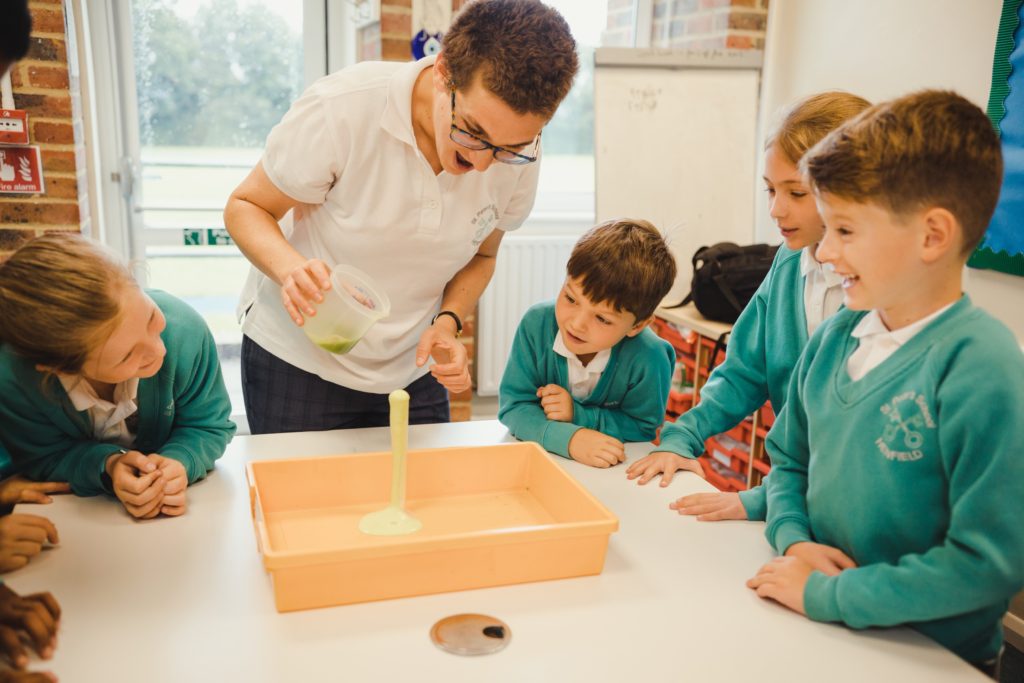
Science in primary school is all about helping children make sense of the world. Lessons are practical, fun and designed to build curiosity and confidence. Children explore ideas, ask questions, and learn through hands‑on experiences rather than memorising facts. This approach ensures science is engaging, meaningful and well‑connected to children’s wider learning.
Assessment and progress
In EYFS, science is assessed within the Early Learning Goals assessment framework. In Year 1 – 5 it is assessed using ongoing formative teacher assessment. In Year 6 a teacher assessment is made as part of the end of Key Stage 2 assessments.
Science attainment is reported to parents annually.
Meeting individual needs
Adaptations are used to ensure that the same content is made accessible to all learners. It is aimed at removing barriers to learning, not restricting what is learnt. To these ends, the following takes place:
- Lots of practical, hands‑on investigations.
- A focus on vocabulary at the beginning of every lesson.
- Recap tasks at the beginning of every lesson.
- The use of talk partners to clarify thinking.
- The use of’ I do, we do, you do’ to deliver content at certain points in the lesson.
- The use of dual coding of information and instructions on teaching slides (adding illustrations to words.)
- Mixed‑ability group work with clear roles eg who is going to measure.
- Adaptations made for recording learning eg labelling a diagram with labels to select from.
How parents and carers can help at home
- Keep it fun and low‑Pressure: The goal of primary science is to build curiosity, develop questioning skills, encourage observation and reasoning, not to memorise facts. Keep an eye on the current medium term plan to see what science is going to be studied that half term.
- Encourage curiosity and why questions to develop scientific enquiry as well as accumulate facts. Don’t feel the pressure to already know the answers: find out together.
- Use everyday activities as opportunities for scientific enquiry eg cooking, gardening, going for a walk, rock pooling, playing in the bath….
- Use and develop age-appropriate scientific language eg lighter/heavier, solid/liquid, observe, measure
- Read scientific books together, following an interest as well as developing a new one.
Resources & usefull links
BBC bitesize for videos and quizzes
https://www.bbc.co.uk/bitesize/subjects/z2pfb9q
STEM learning (science, technology, engineering and science)
Links to activities that can be done at home:
https://www.stem.org.uk/stem-ambassadors/stem-at-home
Science sparks
Activities that can be done at home:
The Woodland Trust
Activities for outdoor learning (typically done in Autumn or Summer terms)
https://www.woodlandtrust.org.uk/learning/children-and-families
Documents to download
Long term plan
Our Science Skills Progression document can be view by clicking here
Subject lead
tbc
Reviewed 08.04.26 /MF