


Music
Our intent
Our curriculum for Music aims to develop creative learners who are inspired to reach their full musical potential; as singers, musicians, composers and music appreciators. Through their experiences children will discover and explore music from different cultures, eras and genres developing an understanding of the diverse world in which we live, where music brings together and reflects community. Our hope is to engender a love and life-long passion for music for all our children.
Shout for Joy to the Lord, all the earth, burst into jubilant song with music; Psalm 98 v. 4
What pupils will learn
EYFS: To keep a steady beat, sing songs from memory, explore untuned percussion, create a class composition and perform together in a year group production.
Year 1: To explore rhythm, link symbols to sounds, sing using their voices expressively, explore and play tuned and untuned percussion, create a class composition, begin to talk about the music they listen to and perform together in a year group production.
Year 2: To develop rhythm, begin to read music, sing in pitch, begin to play the recorder (3 notes) and explore glockenspiels, create a group composition, begin to use musical terms to describe the music they listen to (music appreciation) and perform together in a year group production.
Year 3: To sing with more control, develop reading music, develop recorder playing (4 notes), begin to play the glockenspiel, begin to improvise, create a group composition, further develop musical appreciation, begin to understand about musical periods and perform together in a year group assembly.
Year 4: To sing in rounds and with partner songs, further develop reading music, develop recorder playing (5 notes), learn to play the glockenspiel, begin to improvise, create a small group composition, continue to develop musical appreciation, understand the idea of musical periods and perform together in a year group assembly.
Year 5: To begin to sing in harmony, continue to develop reading music, recorder playing (7 notes), playing the glockenspiel, improvisation, musical appreciation, create a small group composition, begin to identify elements within a musical period and perform together in a year group assembly.
Year 6: To sing different parts and harmonies, continue to develop reading music, recorder playing (9 notes), playing the glockenspiel, improvisation, musical appreciation, create a small group/individual composition, confidently identify elements within a musical period and perform together in a year group production.
How we teach Music
Music teaching follows a spiral curriculum where children build on the skills and knowledge they have learned in the previous year. Children revisit concepts, further developing them within a widening experience of musical pieces. It is taught weekly by class teachers for 2 terms of the year using a variety of resources including Charanga (West Sussex Music developed scheme of music teaching). Each year group will sing, play, create, listen and perform music with teaching linked to topic themes, except when learning to play an instrument. Singing Assemblies are an integral part of our musical teaching where listening and appreciation of music is developed alongside the children’s singing skills.
Extra-curricular opportunities
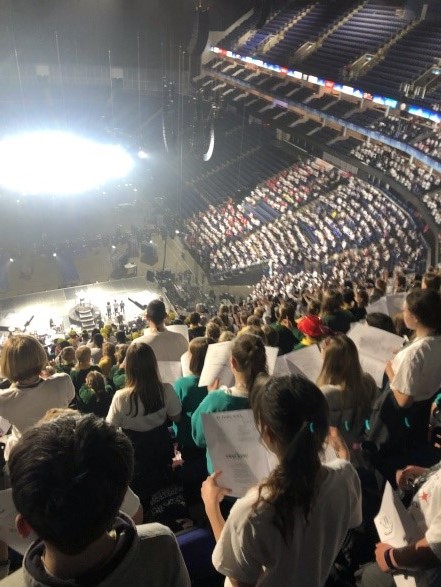
Children in KS2 take part in a local singing festival and Y6 children sing at the O2 with other schools from the South of England. Singing Club meet weekly after school and take part in local festivities, singing at local residential homes and support groups and taking part in Henfield Garden and Arts. Recorder club enables the children to extend their recorder playing and perform in a small group. We have a variety of peripatetic music teachers coming in to the school to teach woodwind, strings, guitar and piano, and Rock Steady Music also run weekly sessions culminating in end of term performances by each band. All of our musical talent comes together in the Spring term to take part in the annual Spring Concert.
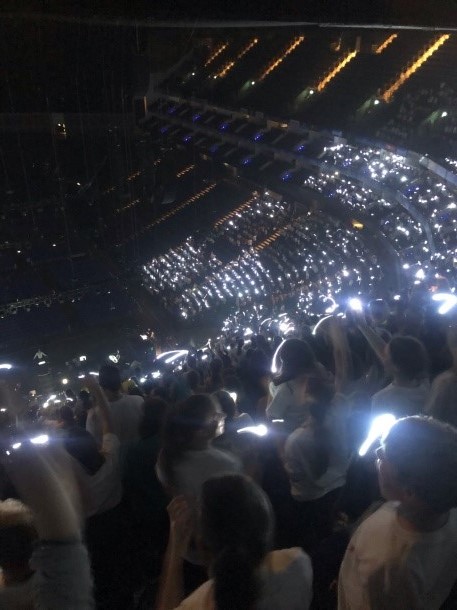
Year 6 at the O2 arena to sing with thousands of children from primary schools from across the South of England.
Assessment and progress
During lessons, teachers monitor children’s progress and provide feedback which helps them adapt and improve their singing, playing, or composition. Through ongoing questioning and revisiting prior learning, misconceptions can be addressed, allowing teachers to offer additional support or appropriate challenge.
Because of the practical nature of music education, all units of learning culminate in a performance: whether singing, playing an instrument, or presenting a composition. These performances showcase each child’s musical development over the term. Teachers use this information to make judgements about pupils’ knowledge and skills, track progression, and inform future teaching. This also supports accurate reporting to parents at the end of the academic year.
Meeting individual needs
To ensure that all children can fully partake in music education and reach their full potential certain adaptations can be made to provide extra support or challenge.
- Visual aids and clear, step‑by‑step instructions are provided, with musical pieces taught in manageable stages.
- When singing, Makaton signs are used to support participation, enabling even our youngest children—who may not yet be able to read the lyrics—to join in.
- Instruments are adapted where necessary, with clearly labelled note names or additional support such as hole covers for recorder playing.
- When reading music, notes can be labelled for those who need it, while confident readers can use standard notation.
- During singing or playing, harmonies may be developed by the children or introduced as an additional challenge.
- During improvisation and composition sessions, children have opportunities to collaborate or work independently at a pace suited to their needs.
How parent and carers can help at home
- Encourage a musical atmosphere at home, playing music regularly
- Talk together about the music you hear, and the music you enjoyed as a child. Listen out for instruments, explore musical genres, talk about what you like or dislike about the music
- Sing songs and rhymes with your children
- Create a time and space for children to regularly practise their musical instruments
- Create musical instruments together out of junk modelling, or explore the musical technology available online
Resources & useful links
https://www.bbc.co.uk/teach/bring-the-noise
https://www.bbc.co.uk/teach/ten-pieces
https://musiclab.chromeexperiments.com
https://www.youtube.com/musicwithmrgray
https://www.youtube.com/@MisterRowsMusic
For instrument tuition www.westsussexmusic.co.uk
Documents to download
Our Music Skills Progression document can be view by clicking here
Music Development Plan 2025-26
What our pupils say…
“I like it because I can forget my feelings and just sing.” (Singing Assembly)
“I like singing and learning new songs.”
“I like playing the recorder because it’s fun and there’s all kinds of cool notes.”
“Music teaches us different skills to help us with what we do.”
“We like finding the beat in music. It really gets you going, you know when to start and when to stop.”
“We think it’s fun!”
“We don’t do enough!”
Subject lead
Mrs A Powell
Last reviewed: 18.03.26 / AP