


EYFS (Early Years Foundation Stage)
“Let the little children come to me, and do not hinder them, for the kingdom of God belongs to such as these.” Matthew 19 v 14
“Children learn as they play. Most importantly, in play children learn how to learn. ” ~ O. Fred Donaldson
Subject Intent
During their time in the EYFS at St Peter’s our aim is for our children to become well rounded, happy and confident individuals with a positive attitude to school and a love of learning. Our EYFS curriculum is designed to encourage independent, inquisitive and happy learners whilst preparing them to reach the Early learning Goals.
We recognise children’s prior learning and various starting points and create a holistic play-based curriculum that maximises cross-curricular links and is centred around first hand experiences, building strong foundations for their future. Our EYFS curriculum is specifically designed and evolves to provide children with important foundational skills and knowledge that will later be enhanced and embedded in KS1.
We believe that all children deserve to be valued as an individual and we are passionate in allowing all children to achieve their full, unique potential. We work closely with our feeder Nurseries to ensure a seamless transition to school; we begin each new year by looking at the individual needs of our children and – taking into account their different starting points – we then carefully develop our flexible EYFS Curriculum which enables them to follow the path of their learning journey, at a point, that is suitable for their unique needs and stages of development.
What pupils will learn?
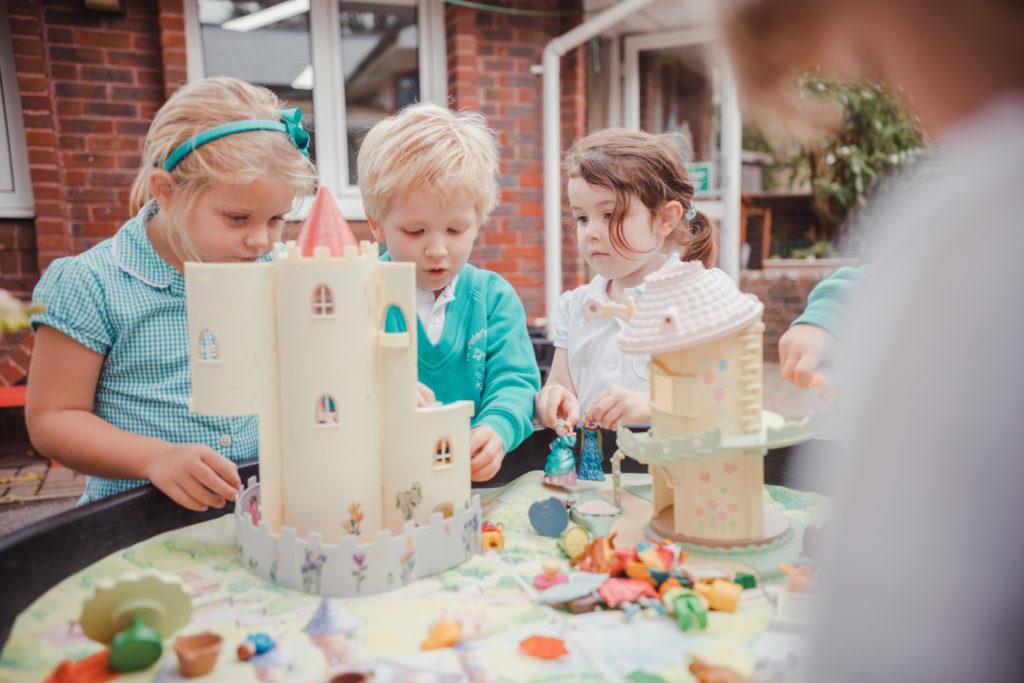
Since September 2000 a ‘Foundation Stage’ has been established for our youngest children. It gives this very important stage of education a distinct identity and is rooted in play-based learning and practical activity both indoors and out of doors.
Our curriculum is based on The Early Years Foundation Stage curriculum (2021) which incorporates:
Three Prime areas which work together to support development in all other areas
- Personal Social and Emotional Development
- Communication and Language Development
- Physical Development
Four Specific areas which include essential skills and knowledge
- Literacy – we use the ‘Read Write Inc‘ scheme for phonic learning which continues into KS1.
- Maths – we the NCETM scheme of work alongside some aspects of the White Rose scheme of work
- Understanding the World
- Expressive Arts and Design
How we teach the EYFS curriculum
The children learn through a balance of child-initiated and adult-directed activities and challenges. The weekly timetables are carefully structured so that children have rigorous directed teaching in Literacy, Maths and Phonics every day. We also ensure regular Circle Time/ PSHE sessions to focus on C&L and PSED and Topic sessions to focus UTW and EAD. These sessions are followed by group work where children work with a member of staff to develop their individual skills. This focused group time enables the teacher to systematically check for understanding, identify and respond to misconceptions quickly and provide real-time verbal feedback which results in a strong impact on the acquisition of new learning.
Children are provided with a wealth of opportunities to engage in ‘exploration’ throughout a variety of experiences, which are carefully planned to engage and challenge them in our provision. The curriculum is planned for the inside and outside classrooms in a cross-curricular way to enable all aspects of the children’s development as well as to promote sustained thinking and active learning.
Our curriculum is delivered through enquiry-based projects that change each term. These ensure coverage of our curriculum as the focus subjects are different foreach one. For more information see our class pages.
Assessment and progress
In the Early Years Foundation Stage, assessment is about understanding each child’s development through observation and interaction rather than formal testing or assessments. This is done through:
- Observations of children during play and adult-led activities
- Interactions and conversations to assess understanding and language
- Looking at work and creations (drawings, models, mark-making)
- Photographs or videos
- Practitioner notes linked to areas of learning
Termly summative assessments are made to establish if the children are on track to meet Early Learning Goals at the end of the year. At the end of the year the statutory EYFS profile is completed for each child and reported to Parents/Carers, Year 1 teachers and the Local Authority.
Meeting individual needs
Adapting learning in the Early Years Foundation Stage means making provision that is inclusive, responsive, and appropriately challenging. This is tailored to the needs of the individual in a variety of ways including providing a language rich environment, individualised support, environment adaptation, visual supports, open ended tasks and problem solving opportunities.
How parents can help at home
Parents are a key part in a child’s education. We work in close partnership with parents and carers throughout the year to support their learning and to encourage children to reach their full potential. We also aim to promote a smooth transition from EYFS to KS1 by providing children with the knowledge, skills and attitudes they need to succeed throughout their education.
Helping children thrive in the Early Years Foundation Stage (EYFS) is all about building strong foundations through play, routine, and support. Here are five practical ways parents can help:
1. Support Learning Through Play
Young children learn best through play. Encourage activities like building with blocks, role-playing, drawing, and puzzles. These develop creativity, problem-solving, and social skills.
2. Read Together Every Day
Reading regularly builds language, vocabulary, and imagination. Talk about the story, ask questions, and let your child predict what happens next to boost understanding.
3. Encourage Independence
Let children try simple tasks like dressing themselves, tidying up toys, or choosing activities. This builds confidence and self-reliance—key skills in EYFS.
4. Practice Early Maths and Language Skills
Use everyday moments to teach:
- Counting steps, toys, or snacks
- Naming colours and shapes
- Singing nursery rhymes (great for memory and language)
5. Keep a Consistent Routine
A regular routine for meals, play, and bedtime helps children feel secure and ready to learn. Good sleep and structure make a big difference in behaviour and focus.
Resources & useful links
RWInc
Oxford Owl
Best Start in Life: Preparing for school
Getting ready for school government document
Documemts to download
Parent Workshops: Funky Fingers, Reading, Phonics
Our Reception children tell us that they like Reception because:
… of my friends. I have lots!
… I love playing outside, especially the sand and doing drawing and painting.
… I like learning big numbers, like ‘teen numbers’.
… we have a whiteboard. I draw cool things like roller coasters!
Our parents tell us:
“My son has had an amazing year in Reception. It is so well organised and the staff are very experienced and nurturing. It is obvious that the staff really care about each pupil.”
“It feels very welcoming and nurturing for the children which at their age is very important. Encouraging parents to be part of their learning journey also is great to see.”
“Children are always very happy, great nurturing environment and excellent resources for the children.”