


Mathematics
Our intent
Our curriculum for Maths aims to develop learners who:
- Are fluent in the fundamentals of maths. They can recall key number facts accurately. For example, being able to add and subtract numbers mentally and efficiently or solve times table problems.
- Have a secure understanding of the ‘why’ behind the mathematical methods they are using. They can reason and use accurate mathematical language to explain their mathematical thinking.
- Can solve a range of problems, including in real world application of Maths. Children are equipped to break down more complex and unfamiliar problems.
What pupils will learm
EYFS: Children in Reception will learn the early fundamentals through play-based activities. They will focus on developing aspects such as a strong number sense, understanding quantities to 10 as well as developing pattern recognition.
Year 1: Children will continue to develop their sense of number and will be able to recognise numbers to 100. They will develop their confidence in being able so solve addition and subtraction problems within 20. They will be able solve simple grouping and sharing problems as well as finding half and a quarter. Children will be learning to recognise 2D shapes (such as circles, squares, rectangles, triangles) and 3D shapes (such as cubes, cuboids, pyramids, spheres),
Year 2: Children will develop their understanding of numbers to 100 by being able to order numbers, understand how to they are made up of different combinations of tens and ones and solve addition and subtraction problems within 100. Children will be able to count in steps of 2, 3, 5 and 10. Children will learn the 2, 5 and 10x tables. They will be able to tell the time to the nearest 5 minutes.
Year 3: Children will be working with numbers up to 1,000, understanding hundreds, tens, and ones. They will start using formal column methods for solving addition and subtraction problems with 3-digit numbers. They will be counting in multiples of 4, 8, 50, and 100. Children will be learning 3, 4, and 8 times tables, and multiplying 2-digit numbers by 1-digit numbers. They will also develop an understanding of tenths, find fractions of amounts, and find equivalent fractions.
Year 4: Children will be ordering and comparing numbers beyond 1,000 and using negative numbers. Children will continue to develop their addition and subtraction using formal methods such as the column method, as well as developing mental maths strategies. They will be multiplying 2-digit and 3-digit numbers by 1-digit numbers and understand division remainders. Year 4 will learn all times tables up to 12×12.
Year 5: Children will be reading, writing, ordering, and rounding numbers up to and understanding powers of 10. They will be using formal column methods for addition and subtraction of large numbers. Children will also be multiplying 4-digit by 2-digit numbers and dividing 4-digit numbers by 1-digit numbers. Children will be finding equivalent fractions, converting between improper fractions and mixed numbers, adding/subtracting fractions with related denominators and working with 3-decimal places
Year 6: Children will be working with numbers up to 10,000,000, rounding, ordering, and using negative numbers in context. Children will be multiplying up to four-digit numbers by two-digit numbers, solving problems using long division, and solving mental calculations using all four operations. They will be adding/subtracting fractions with different denominators, multiplying pairs of proper fractions, dividing fractions by whole numbers, and calculating percentages of amounts. They will be using simple formulas to solve algebra problems.
How we teach Maths
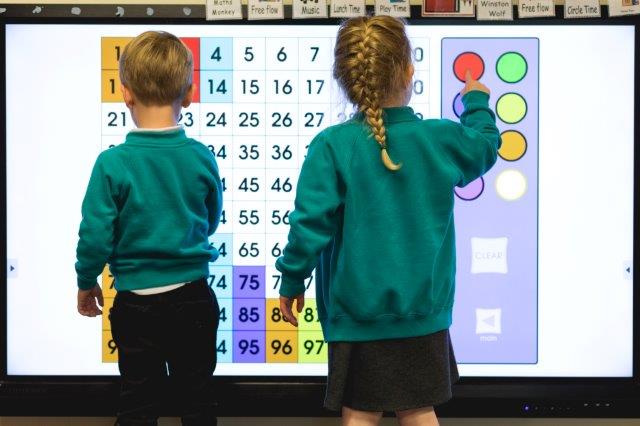
- Maths is taught using a mastery approach, focusing on deep understanding rather than just memorisation of number facts.
- Maths lessons begin with a modelled question from the teacher (I do), then moves onto a guided question and opportunity to practise the concept (We do) before children are given the chance to have a go independently (You do).
- Maths is taught through a CPA approach (concrete – pictorial – abstract).
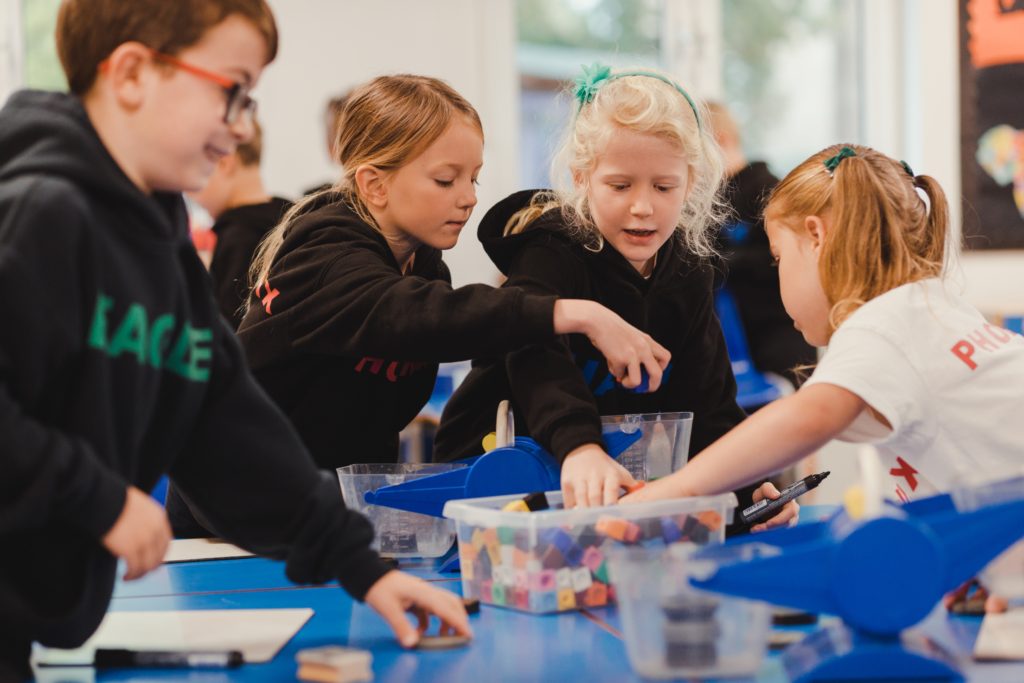
- Children are taught using resources and manipulatives to help them deepen their understanding of ‘the how’ behind the Maths.
- This then progresses to children being able to record and work out problems using a pictorial representation.
- This knowledge is then used to solve problems in a more abstract form, such as through word problems, real life problems and more complex problem-solving questions.
- As well as being able to accurately find the answer, children are taught a range of strategies to help them develop their mental maths.
- Children will learn how to use the most efficient strategy to solve problems quickly.
Assessment and progress
Learning is assessed as part of an ongoing process by teachers. This includes more formal assessments which are delivered every term. Teachers will assess against the National Curriculum objectives. Day-to-day assessment techniques such as questioning, marking, and classroom observations help teachers to assess pupil’s learning and adapt lessons to address misconceptions. National testing happens at two key points:
Year 4: Multiplication Tables Check.
Year 6: SATs tests covering Arithmetic and Reasoning.
Meeting individual needs
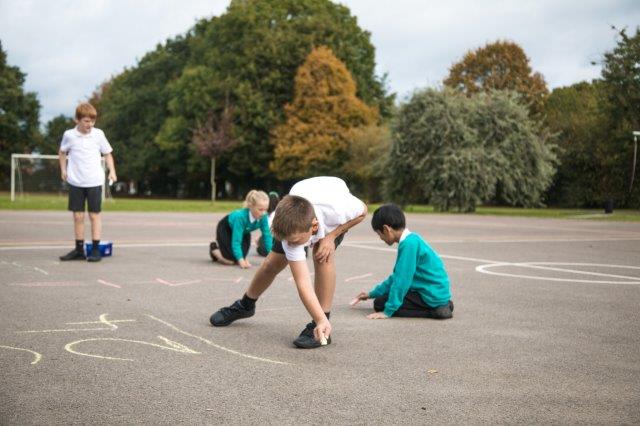
Learning is scaffolded and adapted to support all learners. Resources and manipulatives are available in every class to support every learner. Opportunities for challenge and deeper level questions are offered to challenge pupils further. Quality first teaching to meet individual needs is at the heart of all Maths lessons, and this includes:
- Mastery Approach: Teaching for mastery, ensuring all children have access to the same curriculum content, with deep understanding.
- Concrete-Pictorial-Abstract (CPA) Approach: Using physical manipulatives (e.g., counters), followed by visual representations (pictorial), and finally abstract symbols (numbers) to secure understanding.
- Small Step Progression: Breaking down topics into small, manageable chunks to build confidence and understanding over time.
- Regular Assessment & Feedback: Using live marking, questioning, and ongoing assessment to instantly check for understanding and adapt lessons.
- Explicit Modelling: Showing children how to solve problems and highlighting the thought process behind it.
How parents and carers can help at home
1. Integrate Maths into a daily routine and give real world opportunities. For example: cooking and baking (measuring ingredients, finding half or double quantities, time management), shopping (compare prices, add prices together, find change, calculate discounts through percentages), travel (counting number of cars, spotting odd and even house numbers, calculating travel time).
2. Play Maths games: games with linear numbered boards such as snakes and ladders, card games such as top trumps to compare numbers, dice game like yahtzee, puzzles to support the development of spatial reasoning.
3. Use ‘hands on’ resources and tools: Use household objects such as Lego bricks and pasta to model and support the working out of problems. Let children use tools such as rulers and tape measures to develop their understanding of number as well as supporting measuring.
4. Support the quick recall of number facts such as times tables, number bonds to 10 and 20 and addition and subtraction. Regular opportunities should be given to practise these.
Resources and useful links
https://www.topmarks.co.uk/maths-games/5-7-years/counting (games and activities for children to play)
https://whiteroseeducation.com/parent-pupil-resources/maths/home-learning?year=year-1-new (videos for children to watch to support the learning of different units)
https://whiteroseeducation.com/1-minute-maths (an app for quick maths activities)
https://whiteroseeducation.com/resources/digital-tools (digital tools that childen can use such as rekenreks and double sided counters)
https://ttrockstars.com/ (Times table practise)
https://www.mathsisfun.com/games/index.html
Documents to download
Information on how we teach Addition, Subtraction, Multiplication and Division can be found in the links below to our Progression in Calculation Policy.
- Progress in Calculation Policy – Intro
- Progress in Calculation Policy – Addition
- Progress in Calculation Policy – Subtraction
- Progress in Calculation Policy – Multiplication
- Progress in Calculation Policy – Division
Our maths Skills Progression document can be view by clicking here
Information for Parents regarding Multiplication Tables
KS1 Maths Workshop Presentation
Subject Lead
Mrs S Coulson
Last reviewed: 23.03.26 / SC