


Design Technology
‘Making things seem to be at the heart of what it is to be human, part of our basic make- up as a curious and creative species. To develop these skills in a practical context should form a rich part of every child’s education.’
(Hope, G. Mastering Primary DT 2019)
Our intent
At St Peter’s, Design and Technology inspires children to think creatively, solve problems and develop practical skills for life. Our curriculum teaches pupils to design, make and evaluate purposeful products, considering real users and real needs. We aim for every child to:
- Develop imagination, creativity and practical skills.
- Use technical knowledge, tools and vocabulary confidently.
- Approach challenges with resilience and an iterative mind-set.
- Understand nutrition and healthy eating.
- Recognise how design, technology and innovation shape the world.
Our curriculum covers mechanisms, structures, textiles, electrical systems, and cooking and nutrition, with meaningful links to science, maths and computing.
By the end of Year 6, pupils can plan, design and create high-quality products independently and safely, evaluating their own work and others’ with confidence.
What pupils will learn
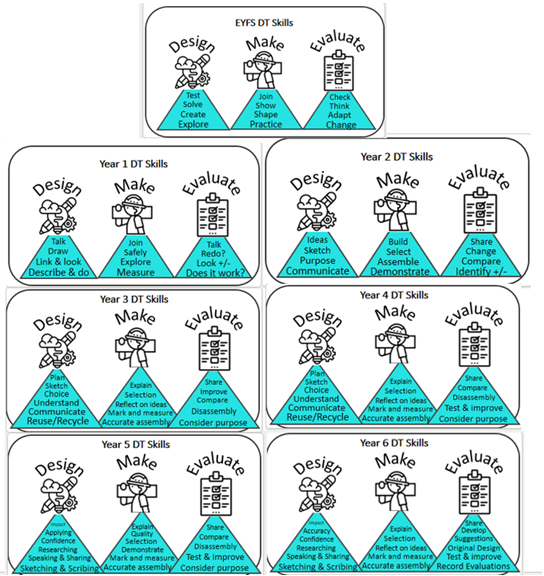
EYFS Children explore materials through play, create simple models and talk about their ideas. They begin to use tools, problem‑solve and evaluate what they have made.
Year 1 Design simple products, communicate ideas through drawings, use basic tools safely and explore simple mechanisms like sliders and levers.
Year 2 Design for a specific user, develop planning skills, use a wider range of tools and materials (including textiles and food) and evaluate against criteria.
Year 3 Use research to inform designs, generate multiple ideas, develop accuracy when measuring and cutting, and learn about mechanical systems such as linkages.
Year 4 Refine and annotate designs, create prototypes, work with simple electrical systems and evaluate with increasing detail.
Year 5 Design innovative products considering materials and sustainability, develop advanced making skills (e.g. gears and pulleys) and evaluate critically.
Year 6 Plan and make high‑quality products independently, use a wide range of tools and electrical components confidently (including programming where relevant), and evaluate using evidence.
How we teach DT
DT is taught through engaging, practical projects that follow the design–make–evaluate cycle. Children build skills progressively from EYFS to Year 6, working with varied materials, tools and systems. Cross-curricular links bring learning to life and help pupils see the relevance of DT in the modern world.
Assessment and progress
Teachers assess learning through observation, questioning and review of pupils’ practical work. Digital tools are used to capture, reflect on and monitor progress. Progress is reported to parents/carers annually.
Meeting individual needs
All pupils access the full DT curriculum through:
- Practical, hands-on tasks
- Explicit vocabulary teaching
- Lesson recaps and talk partners
- The ‘I do, we do, you do’ model
- Visual aids and clear step-by-step instruction
- Scaffolding and structured tasks
- Multi‑sensory learning opportunities
- Flexible recording methods (drawing, verbal explanations, digital evidence)
Support and challenge are tailored so that every child succeeds.
How parents and carers can support at home
Families can support DT learning by encouraging creativity and problem‑solving at home—cooking, building models, exploring how things work, or discussing designs. Asking children to explain their ideas and celebrating effort helps develop confidence, resilience and curiosity.
Resources & useful links
STEM Reosurces for home home
https://www.eathappyproject.com/at-home Eat Happy is the initiative linked to Tesco and ‘Farm to Fork’. On this page there are many useful recipes and activities associated with food preparation. The activities are fun to do and help children to become motivated in finding out where their food comes from.
http://www.teachingideas.co.uk/subjects/dt The Teaching ideas website provides many ideas for various design projects that you can complete with your child at home.
https://www.jamesdysonfoundation.co.uk/ James Dyson’s website has a challenge card page that allows your child to explore their inner engineer.
Documents to download

Subject Lead
Mrs V Thorpe
Last reviewed: 09.04.26